

Buy Heavy Duty Steel Furniture in 2026: What to Know
Table of Contents
- Feature Comparison: What Separates Heavy Duty Steel Furniture From the Rest
- Commercial Grade Steel Furniture: Built for High-Traffic Environments
- Steel Furniture Weight Capacity: How Much Can Your Frame Actually Hold?
- American-Made Heavy Duty Furniture: Why It Costs More and Lasts Longer
- Assembly, Modularity, and Portability: What to Expect Before You Buy
- Maintenance, Safety Certifications, and End-of-Life Disposal
- Frequently Asked Questions
Last Updated: September 26, 2026
Feature Comparison: What Separates Heavy Duty Steel Furniture From the Rest
When you buy heavy duty steel furniture in 2026, you're buying either a decade of structural integrity or a problem. The difference comes down to a handful of specifications most product pages bury or ignore.
Quick Comparison Table
| Feature | Heavy Duty Steel | Standard Steel Furniture |
|---|---|---|
| Frame material | All-steel, welded joints | Thin tubing, bolted hardware |
| Finish | Powder-coated, rust prevention | Painted or bare metal |
| Load rating | Published weight limit | Often unlisted |
| Assembly | Modular, reinforced bracing | Flat-pack, weak connectors |
| Lifespan | Decades with basic care | A few years at best |
| Best for | High-traffic, commercial use | Light residential use |
Commercial Grade Steel Furniture: Built for High-Traffic Environments
For contract furniture in public or rented spaces, lateral stability matters as much as vertical capacity. Push a frame sideways and watch for flex at the joints, that's your real durability test.
Steel Furniture Weight Capacity: How Much Can Your Frame Actually Hold?
Steel furniture weight capacity is the maximum load a frame is rated to support safely, and it should always be published as a specific number. If a seller won't give you one, assume there isn't one.
Weight capacity depends on four things:
- Gauge thickness of the steel tubing, 14-gauge is common for light residential, 11- or 12-gauge for commercial frames, and 7- or 10-gauge for true heavy-duty industrial pieces
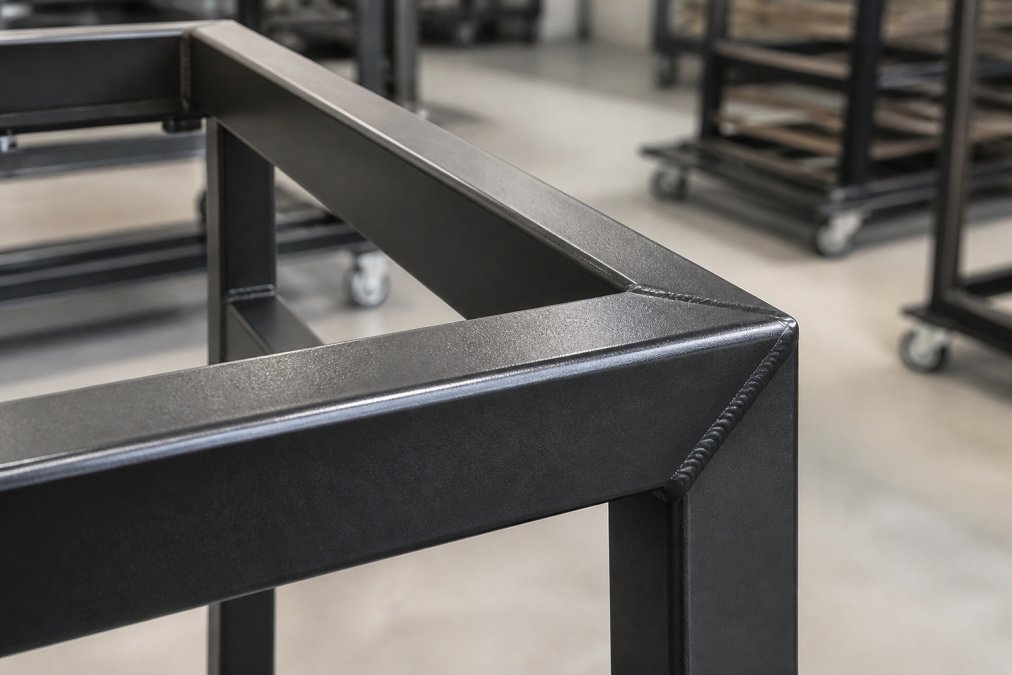
- Joint type, welded joints far outperform bolted ones, and mitered welds distribute stress better than butt welds
- Reinforced bracing at the highest-stress points, such as gussets at corners and cross-members under seating surfaces
- Base geometry, a wider footprint with leveling feet resists tipping better than a narrow base, even when both carry the same static load
How to Read a Load Rating Without Getting Fooled
A published rating is only useful if you know what it describes. Look for:
- Test standard, Is the rating based on a recognized method such as BIFMA X5.1 for seating or ANSI/BIFMA X5.5 for desks? If the maker can't name the standard, the number is marketing.
- Load duration, Some ratings reflect a single static push; others reflect repeated cycles. A frame rated for 1,000 lb once is not the same as one rated for 500 lb ten thousand times.
- Safety factor, Structural engineers typically design to a safety factor of 2 or higher, meaning the frame should hold at least twice its published limit before failing. Ask whether the rating already includes that margin.
- Point of load, A rating for evenly distributed weight is different from a rating for a concentrated load at the edge of a seat or shelf.
Safety Certifications That Actually Matter
- Which recognized standard, if any, does this frame meet?
- Can you provide a test report or a written load rating?
- Is the frame rated for dynamic as well as static load?
A frame built for decades carries a conservative published limit and a clear explanation of how it was derived. A frame built to hit a price point carries no limit, or a number with no method behind it.
American-Made Heavy Duty Furniture: Why It Costs More and Lasts Longer
American-made heavy duty furniture costs more because labor and materials cost more, the honest answer most sellers avoid.
What you're paying for breaks down simply:
- Steel that meets a real gauge specification, not the thinnest tubing that passes
- Welds done by hand and checked, not spot-welded and shipped
- A frame designed to be repaired and maintained, not replaced
Assembly, Modularity, and Portability: What to Expect Before You Buy
Assembly and modularity are where heavy duty furniture either earns its place or becomes a hassle. Portable equipment needs reinforced connectors that hold torque without loosening.
What to check before buying portable equipment:
- Are the connectors rated for repeated assembly cycles?
- Does the frame use reinforced bracing at stress points?
- Can you tighten or replace hardware yourself?
- Is the frame stackable or does it break down flat?
Maintenance, Safety Certifications, and End-of-Life Disposal
Maintenance for steel furniture is minimal but not zero. A powder-coated finish protects against rust and humidity, and a damp cloth handles most cleaning. Check welds and hardware twice a year.
A Simple Maintenance Routine That Prevents Most Failures
Steel frames rarely fail because the metal wears out. They fail because a fastener loosens, a weld cracks, or moisture reaches bare metal. A ten-minute inspection twice a year catches all three.
- Every three months: Wipe the frame with a damp cloth and mild soap. Dry immediately. Avoid abrasive pads, which scratch powder coat and create rust starting points.
- Every six months: Check every bolt, nut, and connector with a wrench. Re-torque to the maker's specification. Pay attention to joints that see the most movement, seat-to-frame connections and any folding or modular hardware.
- Every six months: Inspect welds for hairline cracks, especially at corners and where bracing meets the main frame. A crack that's caught early can often be repaired; one that's ignored becomes a structural failure.
- Annually: Look for chips or scratches in the powder coat. Touch up bare metal with a matching enamel or powder-coat repair pen. Bare steel in a humid environment will rust within weeks.
- In humid or coastal environments: Apply a thin coat of paste wax to exposed steel surfaces once a year. It's an old shop trick that adds a sacrificial layer against moisture.
Safety Certifications and Stability Testing
Safety certifications matter more than most buyers realize. Look for published load ratings and any structural testing the maker provides. guidance from the U.S. Consumer Product Safety Commission on furniture stability is a useful starting point for understanding what stability testing covers, particularly tip-over resistance and anchoring recommendations.
Environmental Resistance: Why Powder Coat Beats Paint
Powder coating outperforms paint because it bonds to the metal rather than sitting on top of it. The powder is electrostatically applied and heat-cured, forming a cross-linked polymer shell that resists chipping, scratching, and moisture far better than liquid paint. In humid or temperature-swinging environments, that difference decides whether a frame lasts five years or twenty-five.
End-of-Life: Steel Is a Sustainability Story
On disposal, steel is one of the most recyclable materials on the planet. the U.S. EPA's overview of steel recycling confirms steel is recycled at higher rates than almost any other material, and steel can be recycled repeatedly without loss of quality. A frame that lasts decades and then recycles cleanly is a genuinely lower-impact purchase than one you replace every few years.
- Repair, Welded steel frames can be re-welded, re-powder-coated, and re-hardwared. A local welding shop can often restore a frame for a fraction of replacement cost.
- Repurpose, A frame that no longer fits its original use can often be adapted for a different one. Modular designs make this easier.
- Resell, Heavy-duty steel holds resale value better than particleboard or thin-tube furniture because the material itself has scrap value.
- Recycle, When a frame truly reaches end of life, take it to a scrap metal recycler. Most accept steel furniture, and some pay by weight.
Customization vs. Off-the-Shelf: When to Commission a Build
Choose off-the-shelf when:
- Your space accepts standard dimensions
- Your load requirements fall within published ratings
- You need the piece quickly and want a return policy
- You're buying one or two units
Choose custom when:
- Your space has non-standard dimensions or obstructions
- You need a load rating above what stock frames publish
- You need specific mounting points, finishes, or integration with existing equipment
- You're furnishing a commercial space and want consistent, repeatable specifications across multiple units
The customization question is worth asking even if you buy off-the-shelf. A maker who understands custom work usually understands structural design better than one who only assembles imported flat-pack.
Frequently Asked Questions
What features define true heavy duty steel furniture?
Look for all-steel construction, mitered or fully welded joints, and a gauge thickness that matches the load. A powder-coated finish resists corrosion and impact. Reinforced bracing at stress points and heavy-duty hardware separate real heavy duty steel furniture from decorative pieces. If the frame flexes when you push it, it will not hold up in a high-traffic environment.
How do mitered welds impact the longevity of steel furniture?
Mitered welds join two angled pieces of steel at a precise corner, creating a continuous bond across the full thickness of the material. That spreads stress more evenly than a butt weld or a bracket. Over years of repeated load and movement, the frame stays square and stable. Cheaper furniture often uses spot welds or bolts that loosen, which is why weld quality is a top predictor of furniture longevity.
Is steel furniture a better long-term investment than wood or plastic?
Steel wins on structural durability. It does not warp, crack, or absorb moisture the way wood can, and it will not fatigue like plastic under repeated stress. A commercial-grade steel frame with a powder-coated finish can last decades with minimal care. Wood and plastic may cost less upfront, but replacement and repair costs add up. For high-traffic or heavy-load use, steel is the more economical choice over time.
What should I look for when buying furniture for high-traffic environments?
Check the weight limit and confirm it exceeds your expected load by a comfortable margin. Look for welded joints, reinforced bracing, and a finish that resists scratches and moisture. Stackable or modular designs help with space-saving. Ask about safety certifications and the return or repair process. If you are equipping a commercial space, request a sample or detailed spec sheet before committing to a full order.